

SiC Wafer Processing Market Expansion Accelerates, Projected to Reach US$ 2,986.44 Million by 2032
SiC Wafer Processing Market Report 2026

QY Research Private Limited India
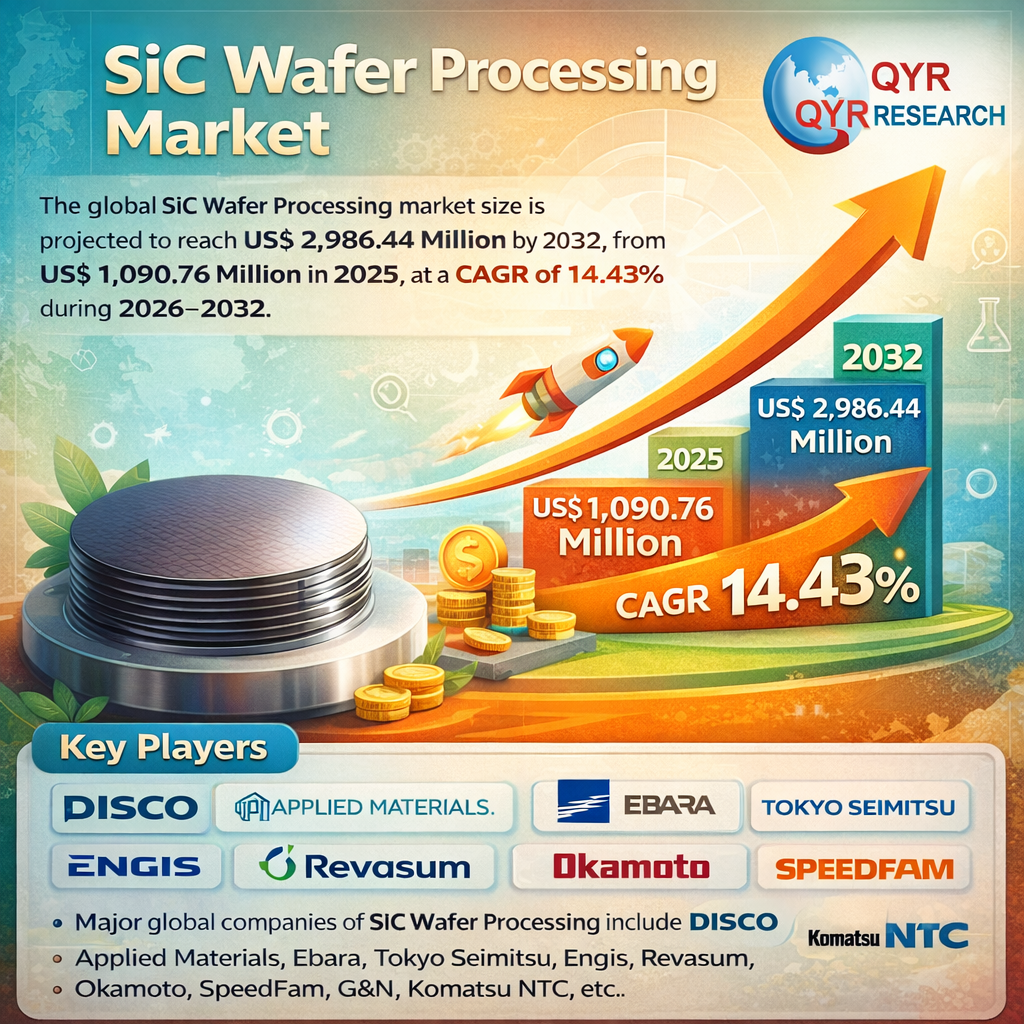
The global SiC Wafer Processing market size is projected to reach US$ 2,986.44 million by 2032, at a CAGR of 14.43% during 2026–2032.
PUNE, MAHARASHTRA, INDIA, February 2, 2026 /EINPresswire.com/ -- The global silicon carbide (SiC) wafer processing market is entering a decisive scale-up phase as electric vehicles (EVs), renewable energy infrastructure, data centers, and industrial automation accelerate adoption of SiC power semiconductors. Between 2025 and 2031, demand growth is expected to remain structurally strong, with the most intense expansion concentrated in the next five years as device makers and integrated manufacturers push capacity additions, yield improvement, and 150 mm-to-200 mm migration. Competitive rankings will increasingly be shaped by defect-density reduction, epitaxy uniformity, polishing and thinning capabilities, and the ability to secure long-term supply commitments with tier-1 device producers.Market Overview
SiC wafer processing refers to the end-to-end set of steps that convert SiC boules and substrates into device-ready wafers suitable for power electronics manufacturing. This includes slicing/wafering, grinding, lapping, chemical-mechanical polishing (CMP), cleaning, inspection and metrology, and—critically for many device roadmaps—epitaxial (epi) growth. As SiC transitions from “strategic supply” to “industrial scale,” wafer processing is becoming a central battleground where material science meets high-volume semiconductor manufacturing.
From an industry structure perspective, the market includes:
1.Vertically integrated SiC leaders expanding internal wafer processing to protect supply and margins.
2.Merchant substrate and epi suppliers competing on quality, scale, and qualification depth.
3.Equipment and services providers enabling higher throughput, tighter tolerances, and improved yield.
Market share and ranking dynamics are strongly influenced by qualification cycles in automotive and industrial end markets. Once a wafer supplier’s process is qualified for a specific device platform (e.g., 1200V MOSFETs or diodes), switching costs can be high—creating a “winner-advantage” for suppliers with consistent quality and proven delivery performance.
Market Key Drivers
1) EV electrification and fast-charging buildout: SiC power devices improve efficiency, reduce thermal losses, and enable compact inverter designs. As OEMs expand EV platforms and 800V architectures, SiC content per vehicle rises, directly lifting wafer processing demand across substrates and epi wafers.
2) Grid modernization and renewable integration: Solar inverters, wind converters, energy storage systems, and high-voltage power supplies increasingly adopt SiC to improve conversion efficiency and reliability. This sustained infrastructure demand supports long-run volume growth beyond automotive cycles.
3) Capacity expansion and multi-sourcing strategies: Automotive and industrial customers are pushing dual- and multi-sourcing, leading to broader supplier qualification and accelerated investments in wafer processing capacity, metrology, and defect control.
4) Yield economics: defect density and process control: Wafer processing is increasingly evaluated on measurable yield impacts—micropipes, basal plane dislocations, surface roughness, thickness variation (TTV), warp/bow, and epi uniformity. Suppliers who can consistently improve these parameters capture higher-value contracts and stronger pricing power.
5) Transition from 150 mm to 200 mm wafers: The move toward 200 mm offers cost-per-die benefits but raises processing complexity. Companies that industrialize 200 mm polishing, cleaning, and epi steps at high yield will likely climb the ranking over the next five years.
Regional Insights
Asia-Pacific (APAC): Fastest scale-up and manufacturing intensity
APAC is expected to remain the largest growth engine for wafer processing capacity additions, driven by aggressive expansion of power semiconductor manufacturing, EV supply chains, and government-backed localization initiatives. China’s ecosystem is progressing rapidly across substrates, epi, and equipment localization, increasing competitive intensity and reshaping global pricing and supply patterns.
North America: Technology leadership and strategic supply investments
North America continues to host major innovation and capacity investments, particularly among vertically integrated SiC leaders and advanced equipment ecosystems. Long-term agreements with automotive and industrial customers remain a defining feature of the region’s market trajectory.
Europe: Automotive pull-through and industrial power electronics
Europe’s position is reinforced by strong automotive demand, industrial automation, and energy-transition projects. European device manufacturers are prioritizing supply security, traceability, and quality systems aligned with automotive qualification expectations.
Competitive Landscape
The competitive landscape spans vertically integrated semiconductor manufacturers, merchant wafer suppliers, and specialized epi providers. Leading players are differentiating through scale, defect reduction roadmaps, and the ability to guarantee multi-year supply.
Notable companies shaping market share and ranking include:
1. Wolfspeed – recognized for scale and long-term supply strategies across substrates and processing.
2. Coherent (incl. legacy II-VI/SiC capabilities) – active in SiC materials ecosystem and processing expansion.
3. SK siltron CSS – building presence in substrate supply and qualification momentum.
4. ROHM Group – deep power semiconductor footprint; strengthened supply chain and processing capabilities.
5. STMicroelectronics – major SiC device producer pursuing supply security and capacity expansion.
6. Infineon Technologies – increasing SiC footprint with multi-source strategies and manufacturing investments.
7. onsemi – expanding SiC platform scale to support automotive and industrial demand.
8. Resonac – active in SiC materials landscape and supply chain development.
9. SICC (and other emerging APAC suppliers) – contributing to expanding capacity and price competition as local ecosystems mature.
Across the next five years, competitive ranking is expected to shift toward companies that can:
1. industrialize 200 mm processing with stable yields,
2. demonstrate repeatable automotive-grade quality,
3. secure equipment availability and process IP, and
4. build resilient supply chains for powders, boules, consumables, and polishing materials.
Market Trends & Dynamics
200 mm industrialization becomes the defining race
While 150 mm remains the volume base, the winners of the next cycle will be determined by consistent 200 mm yields. This will expand the role of advanced CMP consumables, high-precision metrology, and contamination control.
Epi wafers gain strategic value
As device architectures become more demanding, epi quality is increasingly a bottleneck. Uniformity, defect control, and repeatability will command higher margins and tighter customer lock-in.
Long-term agreements and capacity reservation reshape pricing
In a market defined by strategic supply, long-term contracts can stabilize revenue visibility and protect investment cycles—while also tightening competitive access for smaller suppliers.
Localization and supply chain resilience intensify competition
Multiple regions are investing in local supply to reduce dependency risks. This expands the competitive field and creates new entrants, especially in APAC, while raising qualification and auditing expectations.
Reliability and traceability become non-negotiable
Automotive and energy applications require stringent traceability and quality management. Suppliers investing early in statistical process control (SPC), inline inspection, and robust QA systems will be best positioned to capture premium segments.
Outlook: 2025–2031 with a 5-Year Focus
Looking ahead, the SiC wafer processing market is expected to experience its most meaningful structural expansion during the next five years, driven by EV platform scaling, renewable integration, and broader industrial electrification. Through 2031, the industry’s center of gravity will shift from “capacity announcements” to “qualified output,” making yield, quality, and delivery reliability the primary determinants of market share and ranking.
For investors, the key signals to monitor include 200 mm qualification timelines, yield learning curves, long-term contract coverage, and capex-to-output efficiency. For researchers, the highest-impact areas remain defect physics, epi process control, and metrology innovation. For manufacturers, competitive advantage will increasingly depend on vertically coordinated process integration, toolset standardization, and the ability to deliver automotive-grade consistency at scale.
For more information about the SiC Wafer Processing Market Report and its findings, Please Visit: https://www.qyresearch.in/report-details/3791260/Global-SiC-Wafer-Processing-Market
About US:
QYResearch is a leading global market research and consulting company established in 2007. With over 17 years’ experience and professional research team in various cities over the world QY Research focuses on management consulting, database and seminar services, IPO consulting, industry chain research and customized research to help our clients in providing non-linear revenue model and make them successful. We are globally recognized for our expansive portfolio of services, good corporate citizenship, and our strong commitment to sustainability.
Contact US
Ankit Jain - Director, Global Digital Marketing
QY Research, INC.
India Office -
315Work Avenue, Raheja Woods, Kalyani Nagar,
Pune, Maharashtra 411006, India
Web – https://www.qyresearch.in
Email- ankit@qyresearch.com
Ankit Jain
QY Research India
+91 81497 36330
ankit@qyresearch.com
Legal Disclaimer:
EIN Presswire provides this news content "as is" without warranty of any kind. We do not accept any responsibility or liability for the accuracy, content, images, videos, licenses, completeness, legality, or reliability of the information contained in this article. If you have any complaints or copyright issues related to this article, kindly contact the author above.
