

Humanoid Robots Market to Reach USD 165.13 Billion by 2034 at 50.60% CAGR, Led by Asia Pacific Industry
Humanoid Robot Market
Humanoid Robots Market Size, Robotics Innovation Trends, and Forecast 2026–2034
Asia Pacific dominated the humanoid robot market with a market share of 42.60% in 2025”
PUNE, MAHARASHTRA, INDIA, February 8, 2026 /EINPresswire.com/ -- Market Size and Growth Trajectory in 2026— Fortune Business Insights
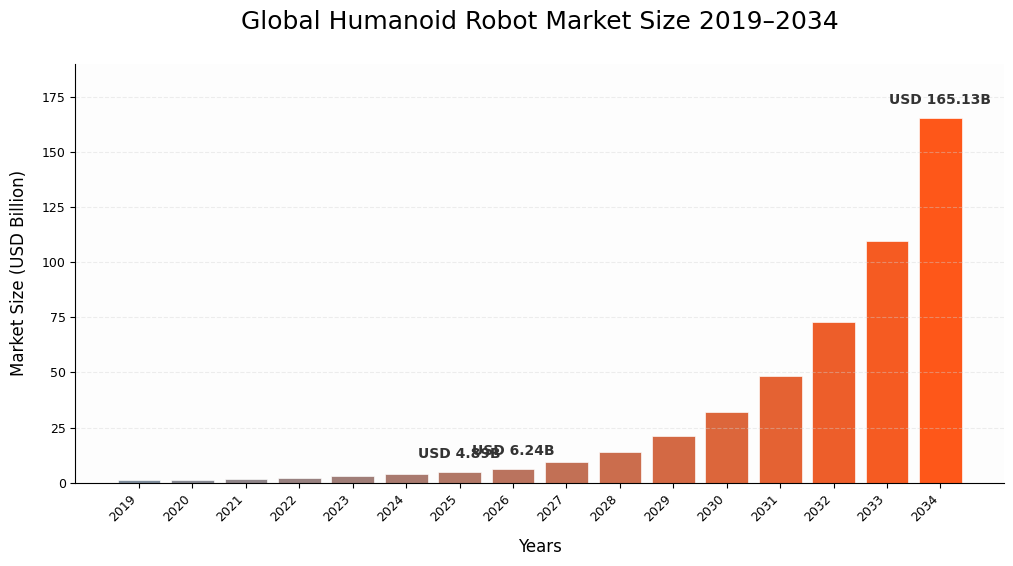
The global humanoid robots market demonstrates exceptional growth potential, valued at USD 4.89 billion in 2025 and projected to expand to USD 6.24 billion in 2026, ultimately reaching USD 165.13 billion by 2034. This represents an extraordinary compound annual growth rate of 50.60% during the forecast period, underscoring the transformative impact humanoid robotics will have across multiple industries. Humanoid robots, designed to resemble the human body in shape and function, have progressed beyond research and development stages in recent years, entering real-world applications spanning research, space exploration, personal assistance, caregiving, education, and entertainment.
Request a Sample PDF: https://www.fortunebusinessinsights.com/enquiry/request-sample-pdf/humanoid-robots-market-110188
Technological Foundation and Development
Building humanoid robots requires integration of multiple engineering disciplines including electrical engineering, mechanical engineering, and software engineering. The convergence of advanced technologies such as artificial intelligence, high-performance computing, next-generation sensors, and battery technologies is accelerating humanoid robot development. AI and high-performance computing enable robots to understand and interact within complex, unstructured real-world environments. AI-equipped humanoids can perform sophisticated tasks including picking and packing objects, utilizing vision systems for autonomous item transportation, and executing maintenance activities more efficiently than human workers.
Next-generation sensors including 3D depth cameras, LiDAR, radar, and voice sensors enable superior environmental understanding and secure human-robot interaction. These advanced sensors closely replicate human sensory abilities, allowing robots to perform sophisticated tasks with precision and reliability.
Regional Market Dynamics
Asia Pacific dominates the global market with a 42.60% share in 2025, valued at USD 2.68 billion. This leadership position is attributed to the presence of major industry players, supportive government initiatives and investments, aging population demographics, and robust robotics culture. China, Japan, and South Korea represent the world's leading industrial robotics markets. According to the International Federation of Robotics, China recorded 290,300 annual industrial robot installations in 2022, capturing 52% market share, while Japan recorded 50,400 units. China's market is projected to reach USD 1.41 billion by 2026, Japan USD 0.29 billion, and India USD 0.11 billion.
In 2023, China's government established ambitious goals to develop humanoid robots by 2025, encouraging companies to focus on humanoid robotics, strengthen international cooperation, and develop reliable industry supply chains. These strategic initiatives are expected to significantly accelerate regional market growth.
North America is anticipated to experience the highest growth rate during the forecast period, driven by rapid technological advancements in artificial intelligence and increased automation adoption. The United States leads the region due to robust academic research, industry innovation, and significant research and development investments from government agencies, private companies, and academic institutions. The United States market is projected to reach USD 1.16 billion by 2026.
Europe's humanoid robot market is primarily driven by labor shortages, increasing labor costs, manufacturing sector automation, robotics hardware innovation including sensors and actuators, supportive government policies, and aging population demographics. Strong research and development investments, AI-enabled robotics integration, and increasing adoption across healthcare, logistics, and service industries further support regional growth. The United Kingdom market is projected to reach USD 0.08 billion by 2026, while Germany is expected to attain USD 0.2 billion.
Market Drivers and Catalysts
Global labor shortages represent a significant market driver, influencing demand across various industries. According to European Commission data from March 2024, approximately 63% of small and medium enterprises in the European Union struggle to find required talent. A 2023 report on German small and medium enterprises indicated 92% of respondents are affected by skills and workforce shortages, with many viewing digital transformation as a means of reducing staff deficiencies. Humanoid robots offer opportunities to address manual labor shortages by augmenting and assisting existing workforce capabilities. Manufacturing companies increasingly adopt robotics solutions to address workforce gaps, as evidenced by luxury automotive manufacturers Mercedes-Benz and BMW announcing plans in 2024 to deploy humanoid robots in production plants to address workforce shortages, improve productivity, and enhance quality control.
Segmentation Analysis
The biped motion segment is predicted to hold the highest market share during the forecast period, accounting for 70.51% in 2026. This dominance is driven by wide applications across healthcare, entertainment, education, research, manufacturing, and maintenance. In healthcare, robots assist doctors during surgical procedures and treatment sessions. Patient care assistants represent typical use cases, with robots performing tasks including vital sign monitoring, medication administration, and providing emotional support through conversation and touch-based interactions. Manufacturing applications include precision and consistency in repetitive assembly line work.
The wheel drive segment is projected to grow at the highest rate due to enhanced mobility, lower development costs, and user-friendly interaction compared to biped robots. Wheel drive robots feature less complexity than biped variants, resulting in reduced maintenance and repair expenses.
By component analysis, the hardware segment is predicted to hold the highest market share at 69.55% in 2026. Hardware components critically determine humanoid robot performance and functionality. Robots require sensorimotor skills to function in human mode and engage in human-to-human interactions, necessitating actuators and various sensors to regulate motions, monitor conditions, and prevent collisions with people or environmental objects.
The software segment is expected to grow at the highest rate due to advancements in software technologies enabling robots to perform complex tasks and operate remotely. Software development has produced valuable insights into handling complexity and developing research projects. Layer software plays crucial roles in processing massive data volumes collected from multiple sensors.
Click for an Enquiry: https://www.fortunebusinessinsights.com/enquiry/book-a-call/humanoid-robots-market-110188
Market Challenges
Market acceptance influenced by infrastructure limitations and high initial investment is expected to restrict short-term growth. Negative public perception and ethical concerns pose significant challenges. As robots become capable of performing complex tasks, they may displace jobs previously performed by humans, particularly in manufacturing. Industry data indicates approximately 14% of workers claim to have already lost jobs due to robots. Addressing these restraints is crucial for building trust in humanoid robots and improving societal acceptance.
Read More Research Reports:
Warehouse Robotics Market Size, Share & Industry Analysis
Airport Robots Market Size, Share & Industry Analysis
Ashwin Arora
Fortune Business Insights™ Pvt. Ltd.
+1 833-909-2966
sales@fortunebusinessinsights.com
Legal Disclaimer:
EIN Presswire provides this news content "as is" without warranty of any kind. We do not accept any responsibility or liability for the accuracy, content, images, videos, licenses, completeness, legality, or reliability of the information contained in this article. If you have any complaints or copyright issues related to this article, kindly contact the author above.
